Muslim Women’s Representation as Comic Book Superheroes
Discourse is important. It helps develop and maintain truth, it fosters the spread of ideology and knowledge, and it comes in a multitude of forms and mediums. Visual communication is one of these forms and is understood using the skill of what is called visual literacy. Using visual and media literacy, we're going to compare and contrast two different, Muslim women superheroes from the Marvel Comics franchise.

These two women, Sooriya Qadir (left) and Kamala Khan (right), are juxtaposed through the ways in which either character disrupts or reproduces the harmful, orientalist tropes of Muslim women that seem to persist among western media. We'll be critiquing their representation based on 3 things:
1) the visual presentation of their overall superhero costume and outfit
2) how the visuals of their first introductions set the stage for the rest of their storyline
3) the role of their respective superpowers and what they communicate about the character themselves
Through these compared examples of visual analysis, it is shown how much of a difference can be made in the positive representation of marginalized identities in the mass media when these representations are determined and created by those who share those same marginalized identity.
This blog post will utilize a range of theoretical and analytical tools from two different academic fields, visual communication design and women and gender studies, that are not commonly combined. The first tool, which is used as the basis of this argument, would be the theory of power, as defined by the French philosopher, Michael Foucault. Foucault states that power is not a physical thing which can be possessed by any person or group. Instead, he posits that it constantly flows, back and forth, through discourse much like energy flows through circuits. In other words, power is something that can only exist within the relationships of two or more people. It cannot be possessed by the people themselves (Foucault 94). Keep in mind, however, that this does not mean that power will always flow equally within these relationships. An individual can still use power to oppress another, even if they do not possess it all by themselves. As such, we will be using this theory as the foundation for examining how power flows through the specific form of discourse that is visual communication, and more specifically, mass media. The analysis of this power and its discourse will be done primarily through a framework of visual literacy.

Visual literacy, unlike verbal or written literacy, is difficult to concretely define and is often debated among experts. It is heavily related to the concept of media literacy, but still not exactly the same. According to B. A. Chauvin, media literacy is an analytical tool that maintains “a focus on three major aspects… the mass media, and on how and for what purpose messages are constructed and consumed by the masses” (Chauvin 122). Meanwhile, visual literacy encompasses, as the name implies, all things visual. This can go beyond the confines of mass media to include “works of art, architecture, body movements, and many other direct signs observed in the natural environment” (Chauvin, 4). Additionally, mass media can involve things, such as radio, which are strictly audio and are, therefore, not included in the study of visual literacy. With such a strong overlap between the two fields, it would be near impossible to include one without the other.
Mass media, according to C. Wright Mills, is characterized by first, very few people communicating to an audience of very many, and second, the inability for the audience to respond (Mills 305). This exemplifies the transmission model of communication, which is a one way, linear discourse where a “sender” encodes (turns thoughts into communication) and transmits a message through a channel to a “receiver” that decodes (turns communication into thoughts) it but does not respond (Ellis & McClintock, 1990).
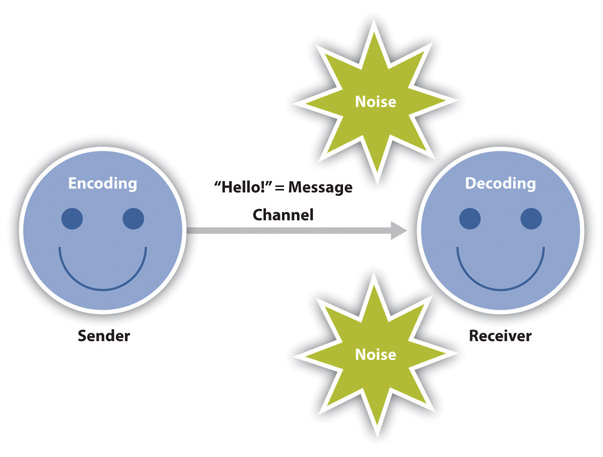
VS
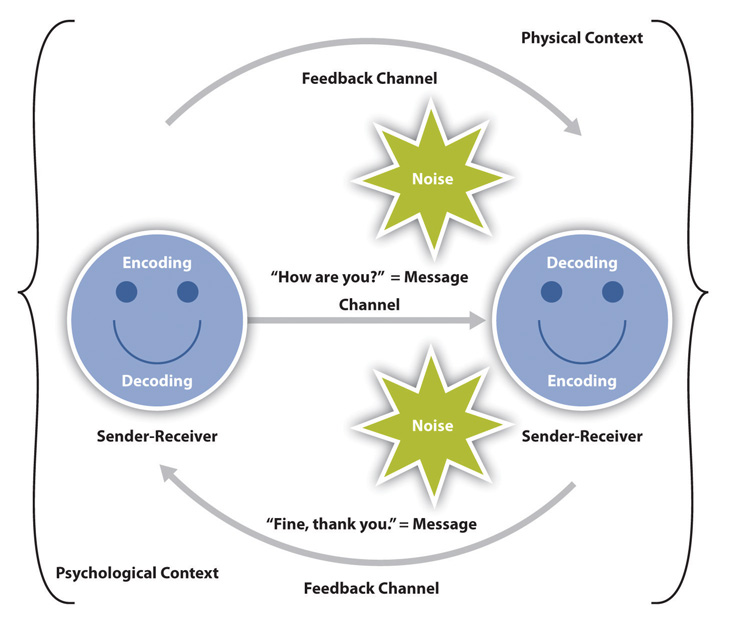
So, when taking this model of communication and applying how Foucault's theory of power works, the result is a slanted or uneven flow of power in the discourse between the few, individual owners of mass media and the audience or general public. This power dynamic allows the elite few to dictate the heavily influential media messages that regulate our lives as individuals and as a greater society. In order to re-calibrate the flow of power to be more equal, the format of the discourse itself must be altered to integrate all agents within the whole process of communication.
Figs. 1. & 2. Kamala Khan (Ms. Marvel) and Sooraya Qadir (Dust)
Kamala Khan (pictured left), a Pakistani-American born Muslimah, was first introduced to the Marvel universe in 2013 to great reception (Gerding 2014). Sooraya Qadir (pictured right), on the other hand, is an Afghani Muslimah, first introduced just over a year after the attacks on September 11, 2001 (Davis and Westerfelhaus 800). Not only are their initial contexts and receptions different, but how they are treated visually, as well, prove to be very distinct. Qadir, in contrast to Khan, really serves as a fetishized icon of the Oriental stereotype. One can see how easily her artist stuck to the common habit in the comic book industry of giving female characters outfits that are significantly more form fitting than they would be in real life. This is especially contradictory when taking into account the fact that she is supposed to be wearing a burqa – one that is not even accurate in its depiction – where the purpose of the garment is modesty and to avoid something so form fitting. Additionally, she is depicted roaming through a desert landscape – no doubt a reference to her ability to turn into a cloud of sand, as well as the common western misconception of what any and all middle eastern regions looks like. This is to say nothing of “the Western media’s seeming addiction to the visual image of the veiled Muslim woman” that is demonstrated throughout her storyline (Enloe 271).
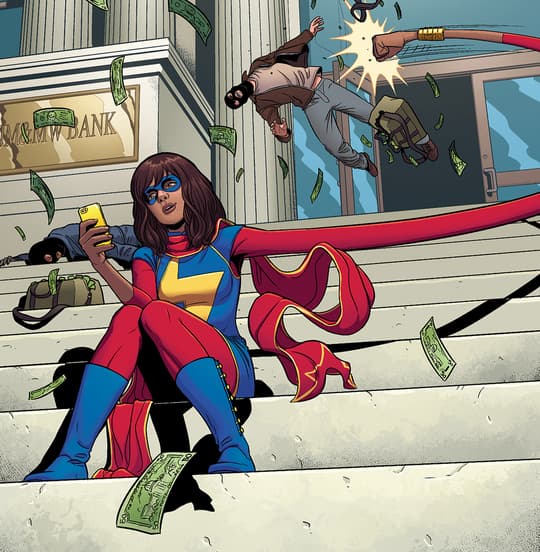
Qadir’s sultry pose and exotic othering provide a sharp juxtaposition to the portrayal of Khan’s character, so much so that one would hardly guess from just these two images that they were both around 16 years old. While Qadir keeps her arms close to her body and hands centered around her hips, splayed out in a gracefully feminine manner, Khan takes a stance that unapologetically occupies more space. Her legs are wide in a firm stance, arms out and fists clenched, ready to fight evil. The composition does not just focus on her body, either. With her scarf flowing out behind her, alluding to the classic red cape of western superheroes, the emphasis of this image is on her being a hero and in a position of power. Especially since this scarf takes up more space in the image than she does. Additionally, Qadir’s all black outfit creates a more solemn and suppressed impression than that of the freeing and expansive red that dominates Khan’s color scheme. In each picture, both figures are composed with an emphasis on the fabric of their outfits flowing out behind them. However, due to color, form, and posture, one is clearly meant to portray a sense of containment while the other looks ready to fly off into the air.
As previously mentioned, mass media’s power lies in the inability to respond on the part of the greater public. This is countered, in part, when there is greater representation of the audience amongst those determining the narrative – or, in the case of comic books, the visual narrative. Such is the case of Kamala Khan, a Muslim woman, who is created and written by Muslim women. However, one must be careful not to fall into the trap of ethnocentric universalism by thinking that this is the absolute solution to the unbalanced power dynamic of the mass media. As much as they are more qualified to create a narrative centering a female, Muslim character, the experience of one or two Muslim women as authors cannot define the lived experiences of all the Muslim women that they hope to give a voice to.
Nevertheless, they certainly do make an effort to provide, within Ms. Marvel’s storyline, a variety of lived experiences as a Muslim. This is seen in both the friends and family that Khan surrounds herself with. As Miriam Kent describes, “With these characters, the book diversifies the notion of ‘the Muslim’ as cast members express their faith differently. Islam is not merely a monolith” (Kent 524). Visually, this is represented in the contrast between Khan and her school friend, Nakia. In fact, this is highlighted in the very first scene of Ms. Marvel’s first issue, establishing the varied experiences right off the bat. Not only are their different experiences illustrated by one practicing veiling while the other does not, but also in their postures – visually representing their personal responses – when concerning the temptation of pork in front of them. It is a rather casual, every day Muslim experience that both handle significantly differently.
Fig. 3. Kamala Khan faces the temptation of eating pork
Qadir, however, is first introduced as a limp, nameless figure in the arms of a western man and in the “need” of saving by another western man from the Taliban slave traders that had captured her. Not only is this portrayal of her done for the sake of the western, male gaze harmful in its racist and sexist implications, but she becomes, essentially, the only portrayal of a Muslim woman within her storyline. The brief exception to this would be when she eventually reunites with her mother, Mirah, in Afghanistan, but even that is an encounter where her mother is portrayed in the same, static, orientalist stereotype that cries over how lucky her daughter is to have been taken to America, to experience freedom from the Taliban.
Fig. 4. Wolverine encounters an unconscious Sooraya amidst the remains of slave traders
This conversation with her mother is further analyzed by Julie Davis and Robert Westerfelhaus:
“…[the conversation] contains an implicit embrace of the secular West’s socio-political order…[and]…a tacit approval of America’s military intervention in Afghanistan, which could be regarded as having liberated Mirah, her daughter Dust, and other women from the repressive Taliban regime. Left unsaid is any criticism of the war and the way it is being waged” (Davis and Westerfelhaus 803).
Such a singular and homogenizing portrayal plays into the harms of ethnocentric universalism, as discussed by Chandra Mohanty (Mohanty 64). It also further plays into the harmful orientalist stereotypes, since, as Juliet A. Williams describes it, September 11, 2001, “the [orientalist] tropes of the Muslim woman in general and the Afghani woman in particular as the ultimate victims of a timeless patriarchy defined by the barbarism of Islamic religion and in need of civilizing have become increasingly prominent in popular discourse” (Williams 617). Qadir’s character, and that of her mother, fit perfectly into this description. Not only are both Afghani, Muslim women – thus, created to for the sake of making a statement on the relations between the U.S. and Afghanistan at the time – but the entire nature of these characters is centered around their suffering at the hands of middle eastern patriarchal systems. As Jehanzeb Dar points out in his article, “Female, Muslim, and Mutant: Muslim Women in Comic Books,” every single male Muslim figure in Qadir’s initial storyline is demonized, whether they are the Taliban slave traders or Pakistani hijackers.
Aside from their outfits and how they make their first, grand entrance into the story, one of the definitive aspects of superheroes is what makes them so super: their powers. Khan’s powers as Ms. Marvel are that of a polymorph, meaning that she can transform her body into virtually anything she desired. This reflects her dynamic narrative as her comic series clearly shows her struggling, as a teenage, daughter of Muslim immigrants, to feel “normal” in the Jersey City suburbs that she grew up in and a desire to become like the former, bombshell blonde Ms. Marvel a.k.a Captain Marvel. While she starts off wanting to feel “normal”, her powers eventually lead her to instances where she distorts her body beyond what is at all physically possible (i.e, an obscenely large fist) – for the sake of crime fighting – which is even further from the established norm than she was before. Her powers become a metaphor for her personal struggles, outside of her superhero identity and add even more dimensionality to her character. They also allow her creators to address the alienation that one with her marginalized identities can feel in society, without making it the sole and only part of her lived experience as a teenaged girl, like they did for Qadir.
For Sooraya Qadir, however, her powers, in combination with her poorly written personality and character, are nothing more than a reflection of how the white men that created her view the exotified other that is the Muslim woman. For starters, her powers of controlling and turning into sand, as an element of nature, create a very essentialist portrayal of women being inherently connected to nature and the earth, while her male teammates get super strength or something along those lines. Additionally, as pointed out by Sophia Rose Arjana in her book, Veiled Superheroes: Islam, Feminism and Popular Culture, “Afghanistan is a largely mountainous region, quite unlike Arabia” (Arjana 12). So, there is not much of a valid connection between her background character and her own powers, other than the typical stereotypes stemming from Western framing.
In conclusion, comic books, as a branch of the mass media, are a medium of visual communication – which means they are simultaneously used as tools of oppression as well as tools of resistance. Both instances can be exemplified with the visual analysis of the Marvel characters, Kamala Khan and Sooraya Qadir. As Muslim women, either character already is starting off with the “short end of the stick”, so to speak, in terms of representation. And they both represent opposite ends of the spectrum in how positive and successful these representations might be. This is shown is some of the vital aspects of what defines a western superhero, typically. In appearance and costume, context of initial appearance/introduction to the storyline, and symbolism of their respective powers, Khan consistently overshadows the portrayal of Qadir through a visual narrative that manages to provide a more in depth, dynamic character that actively disrupts the harmful, yet typical, exotified orientalist stereotypes that Sooraya Qadir’s character falls prey to.
Comments
Post a Comment